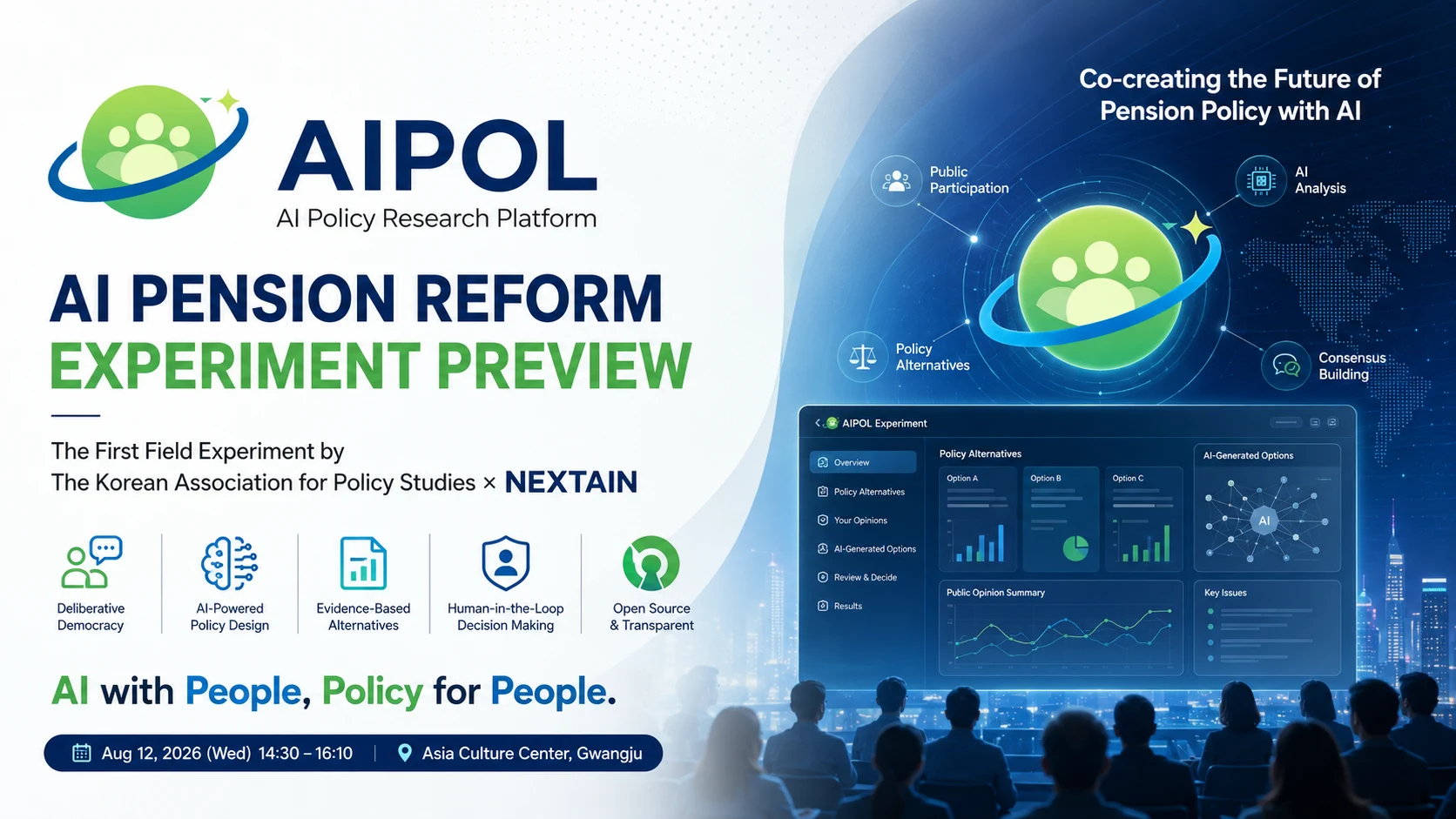
KAPS × Nextain: AIPOL's First Field Experiment
Hello. I am Luke Yang, CEO of Nextain, where we are building the visual AI agent Naia.
South Korea's AI momentum in 2026 is stronger than ever. The semiconductor industry continues to expand, while both the private sector and the government are investing in sovereign foundation models and large-scale GPU infrastructure. AI is now widely regarded as a strategic national asset.
But can AI also help create policies that people can actually feel in their daily lives? Can it participate in defining policy problems, researching evidence, developing alternatives, listening to citizens, coordinating competing interests, and reviewing final decisions?
To examine these questions, Nextain and the Korean Association for Policy Studies (KAPS) launched AIPOL, an open-source AI policy research platform. AIPOL is an AI policy R&D project that tests these questions through real experiments and open-source tools.
Our first application is the “Pension Reform–AI Deliberative Democracy Policy Experiment.” The first field experiment will take place on August 12 at the Asia Culture Center in Gwangju. Ahead of the event, we are conducting expert meetings and pre-field validation. This post explains what we have prepared so far.
Pre-Field Validation with Three Korean AI Models and 100 Synthetic Citizens
Before applying the process in the field, we ran the full workflow with 100 synthetic citizens based on NVIDIA's Korean synthetic persona data. Three Korean AI model families were used. We also recorded how the models generated an additional policy alternative and cross-reviewed it.
- LG AI Research EXAONE family: 20 synthetic profiles
- Upstage Solar Pro 3: 50 synthetic profiles
- NAVER Cloud HyperCLOVA X family: 30 synthetic profiles
The models generated synthetic responses to pension reform alternatives created by experts, proposed an additional alternative, and reviewed it across models. In the first round, none of the three expert alternatives received majority acceptance. When the AI-generated alternative was added, 68 of the 100 synthetic responses accepted it.
However, the AI-generated alternative also changed assumptions that experts had fixed, introduced precise figures that had not been verified, and suggested a schedule inconsistent with the intended implementation period. The result reinforced two important points: a popular option is not necessarily an accurate or valid policy, and AI-generated proposals require expert review and explicit human approval.
For more context and the current public scope, see the AIPOL pension reform case page.
View the public data: The original post omitted the direct link during review. The aggregate results, round-by-round synthetic responses, AI cross-review records, and execution evidence from the pre-field run with 100 synthetic citizens and three Korean AI models are available in the AIPOL detailed synthetic experiment results.
This was a validation of the experiment engine's procedure and recordkeeping using synthetic participants. It is not evidence of public opinion, policy preference, or deliberative effects among real citizens. The policy alternatives and event procedure are still being reviewed and improved through expert meetings.
This Event Is AIPOL's First Field Experiment
The run described above was a pre-field validation and operational rehearsal using synthetic participants, not real citizens.
The “Pension Reform–AI Deliberative Democracy Policy Experiment,” held at the KAPS Summer Conference on August 12, is AIPOL's first field policy experiment with real participants.
 Participants will review pension reform alternatives prepared by experts and submit their own views. They will then see other perspectives, issues summarized with AI assistance, and an additional AI-generated alternative before evaluating the options again. The experiment is not about allowing AI to make policy decisions, nor is it a contest between human-made and AI-made policies. Its central questions are:
- How can AI support policy-alternative development?
- How does AI-provided information influence human judgment?
- How does judgment change after people encounter different views?
- How should people detect and review errors and bias in AI-generated alternatives?
- How should roles and accountability be divided between people and AI in policy development?
Our objective is to examine these questions through an actual process.
The KAPS research team and participating experts are continuing to review the policy alternatives, survey questions, scope of AI involvement, human approval steps, and methods for interpreting the results. The detailed experiment design and pre-field findings will be explained at the event.
Open-Source AIPOL: Open to Review and Reuse
 The green in the AIPOL logo represents open source: research outputs and tools that people can review and improve together. The three human figures represent democracy, in which citizens with different views discuss and shape policy together. The orbiting star represents AI—not replacing people, but moving among their perspectives to surface new issues and possibilities. The logo captures AIPOL's goal: a human-centered process for making policy with AI.
AIPOL is more than an event website. Researchers can create policy experiments and issue participation links. Participants can move through information and consent, a pre-survey, review of expert alternatives, opinion submission, review of an additional AI-generated alternative, and final selection in one connected flow. The platform is designed to operate policy experiments, and its source code is publicly available on GitHub.
We built it as a reusable platform rather than a one-off tool for this event. If you are interested in using it, please contact us.
AIPOL also provides a global trends page and an RSS feed, summarizing official materials from governments and international organizations on AI-assisted policy development in Korean.
The AI drafting feature for the global trends page was implemented with Solar Open 2, an open-weight model made available through support we received by participating in an Upstage developer event. We validated its ability to turn official sources into structured Korean drafts. The site distinguishes material that is already public from automation that is still being prepared.
Why Is Nextain Working on This?
AI-assisted policy development is attracting strong interest from governments and public institutions. Before founding Nextain, I worked at South Korea's Software Policy & Research Institute (SPRi). I wanted to run experiments like this even then, but the technology and environment were not yet ready. The technology has now advanced enough for Nextain to make a serious contribution in this field.
Personally, I believe AI may eventually be able to do some parts of politics better than people. AI can be relatively free from family problems, financial pressures, and personal conflicts of interest that can affect human politicians. I even have a provocative long-term idea: an “AI Party” made up of engineers who propose and verify policy through code, data, and publicly inspectable evidence. The era of living and working with AI is already close.
Related Links
- AIPOL
- Event information
- Pension reform case and pre-field validation context
- Method and run process
- Detailed results from the 100-synthetic-citizen experiment
- Global trends
- Public source code
#AIPOL #KAPS #Nextain #AIPolicy #PolicyDevelopment #AIAgent #DeliberativeDemocracy #PensionReform #EXAONE #Solar #HyperCLOVAX #OpenSource