Would You Support a National Pension Reform Drafted by AI?
A national pension reform that will determine your retirement. If you participated in having AI draft it, would you support it? How much more to pay, and how much and when to receive—the national pension is directly tied to your salary and old age. Those who will pay premiums in the future and those who will soon receive pensions naturally have different concerns. On such a complex issue of conflicting interests, whose opinions will AI reflect, and what might it miss?
Hello, I'm Luke, creator of the AI agent Naia. While I usually share stories about developing with AI, today I'd like to invite you to a slightly different experiment I've been involved in developing.
This is an online study with experts from the Korean Association for Policy Studies, exploring how AI can help people discuss pension policy.
To be clear, this is not an experiment where AI makes policy decisions.
 Based on materials prepared by experts and discussions among citizens, AI helps organize opinions and draft policy proposals. It is you who reads, discusses, and judges the content.
More Important Than the AI-Generated Proposal: The Reasons You Choose
For this experiment, the Korean Association for Policy Studies and Nextain have created an open-source online policy research platform called AIPOL. This experiment involves an online process where you review pension reform proposals, record your choice and reasons, and then reconsider based on others' opinions and AI-summarized content.
Even if people choose the same proposal, their reasons may differ. Some worry about the immediate burden of premiums, while others fear insufficient retirement income. Even among those who disagree, there may be common values they want to protect. If AI organizes these reasons and conditions, could it help us better understand our own choices and differing opinions? And if we see a policy draft written to reflect those opinions, might our judgment change?
The research question is not 'Do people follow AI's answer?' but 'Can AI help people understand each other's differences and reduce conflict?'
The plan was to have about 250 citizens discuss national pension reform proposals, receive AI assistance, and then observe how choices and opinion gaps across generations and income levels change. This online participation is an opportunity to continue that inquiry.
AI Does Not Decide Policy; It Helps Develop Policy
AI does not independently produce new policies as if they were the correct answer. It organizes content and helps draft proposals based on pre-supplied materials, policy tools, and opinions left by people during discussions. The research objectives, materials, criteria, and final decisions are made by humans.
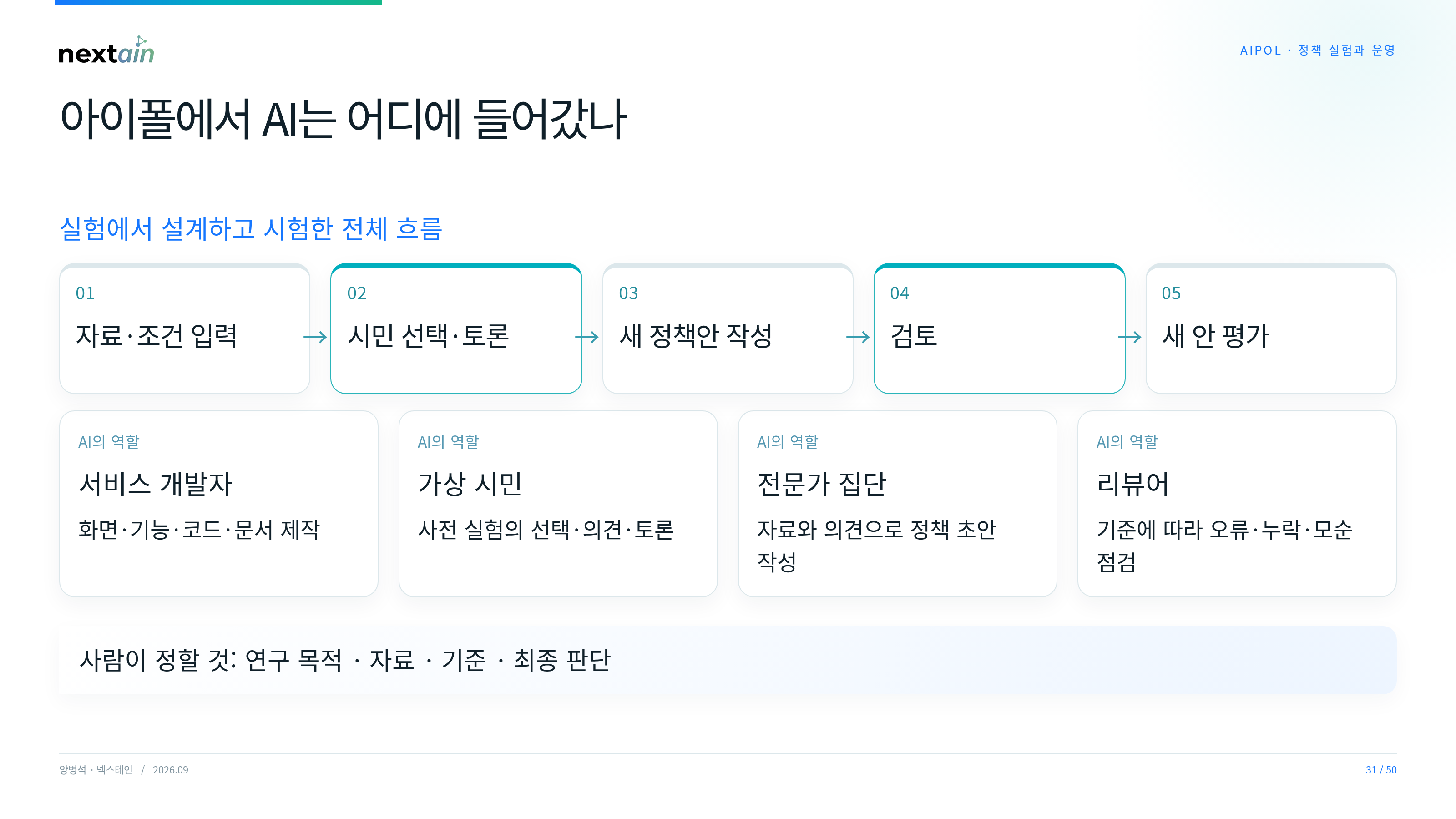 'Where AI fits into AIPOL.' The flow utilizes AI for service development, virtual citizen simulation, drafting policy proposals based on data and opinions, and review. Research objectives, data, criteria, and final decisions are set by humans.
Of course, during the organization process, important opinions may be omitted or meanings may shift. That's why human review is necessary. Nor do we pre-conclude that AI will reduce conflict. This is a study to find out whether AI helps or, conversely, misses something. The voting in this experiment is not a vote that determines actual pension policy.
Overcoming On-Site Regrets, Reopening Online
The previous on-site experiment by the Korean Association for Policy Studies received much attention. This experiment, prepared jointly by pension and AI experts with citizen participation, was also introduced by Asia Economy as a case where citizen opinions and AI analysis were used to draft a national pension reform proposal.
However, on-site infrastructure issues such as connection overload prevented us from completing all the prepared participation procedures. Although we conducted pre-simulations and tests, it was my responsibility that we did not fully verify the actual operating environment. I apologize to the participants who waited, and I deeply thank President Lee Seok-hwan and everyone who helped us wrap up the on-site event smoothly.
Starting from the train ride back, we worked on infrastructure replacement and testing, and decided to reopen online in time for the fall academic conference. This time, instead of completing the entire process in one hour, we opened it in stages by period for participation. The final results will be presented again at the 2026 Korean Association for Policy Studies Fall Academic Conference, held from October 15 to October 16, 2026, at the Korea Arboreta and Gardens Management Agency (National Sejong Arboretum), and we will share them online as well.
Which Pension Reform Proposal Would You Support?
AI is transforming many things, and some worry that AI will dominate humanity. AI can aggregate and analyze a very complex world and countless opinions to mediate conflict. This opens another possibility for democracy with AI. And ultimately, it is we who choose and implement those policies.
Why not take part in this experiment of possibility?
What this study needs is not just AI's answers, but your thoughts. Participate right now.